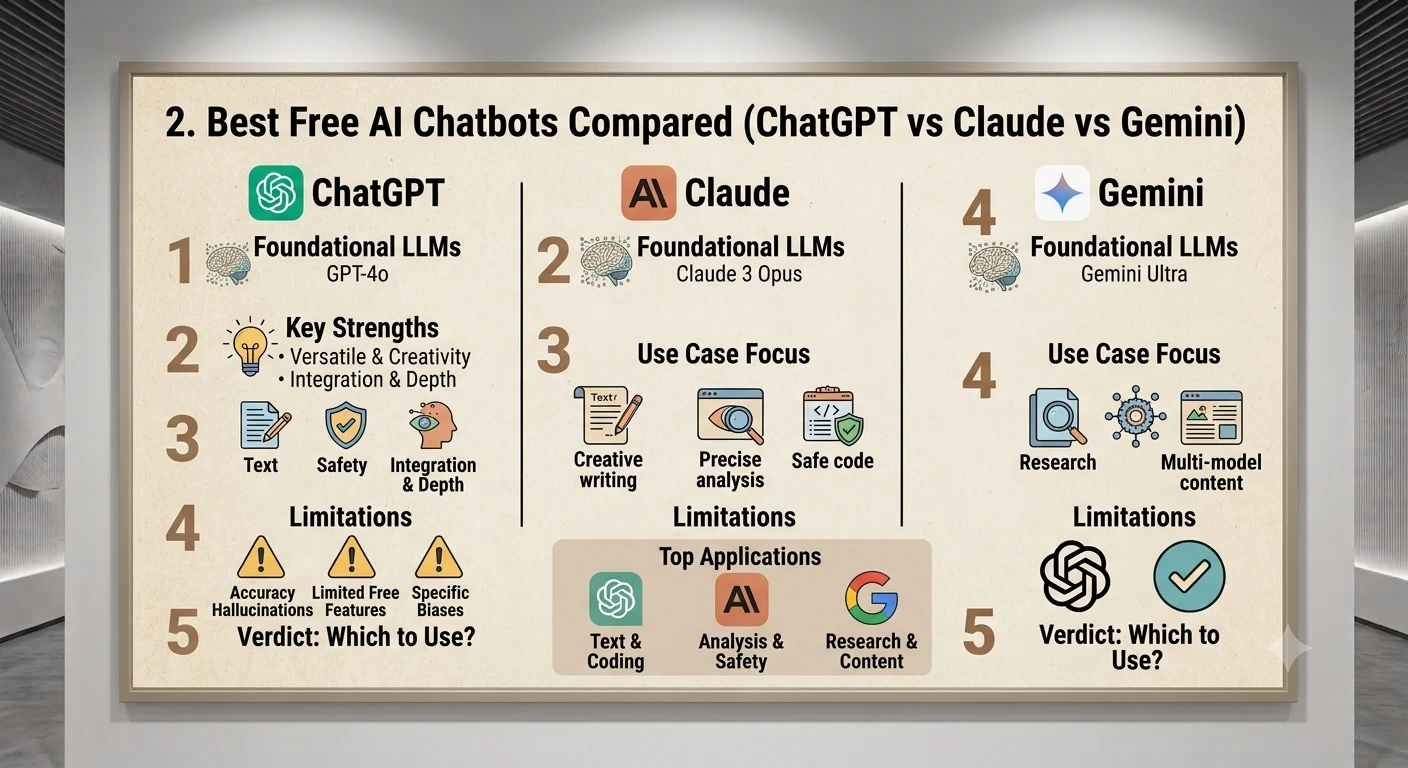
A head-to-head look at the three biggest free AI chatbots and where each one actually wins.
1. Introduction — Why Compare Free Plans?
ChatGPT, Claude, and Gemini are the three most widely used AI chatbots in the world, made by OpenAI, Anthropic, and Google respectively. All three offer a genuinely usable free tier — not just a time-limited trial — which means most people can try serious daily-driver AI assistance without paying anything.
But "free" doesn't mean "identical." Each company makes different trade-offs: which model you get access to, how many messages you can send before hitting a limit, which extra tools (web search, image generation, file uploads) are unlocked, and how your data is used. This guide breaks down those differences in plain language so you can pick the right free tool — or combination of tools — for what you actually need.
2. Quick Verdict
- Best all-around free plan: ChatGPT Free — the most generous general-purpose usage, plus web search, image generation, and file analysis.
- Best for writing quality, reasoning, and careful answers: Claude Free — smaller message allowance, but many users find its writing and coding output more careful and less "generic."
- Best for Google ecosystem users and long documents: Gemini Free — tightly integrated with Gmail, Docs, and Drive, with a very large context window for pasting in long text.
- If you want maximum access to top-tier reasoning models for free: none of the three give unlimited access to their most powerful model for free — that's the main thing every paid plan sells.
3. ChatGPT Free — Overview
Made by OpenAI
ChatGPT's free tier runs on a fast, everyday model (OpenAI's "Instant" tier), with usage that resets on a rolling window. It is generally considered the most generous free tier for everyday conversational use, and OpenAI has continued to add free-tier tools over time rather than stripping them away.
- Model access: A fast default model for most conversations; OpenAI's most advanced reasoning model is reserved for paid plans.
- Included tools: Web search, file and image uploads with basic data analysis, limited image generation, and limited access to custom GPTs and deep research.
- Limits: Message caps that reset every few hours; heavier tools like image generation and deep research have their own tighter caps.
- Good for: Quick questions, drafting and rewriting, summarizing documents, everyday research, and casual coding help.
4. Claude Free — Overview
Made by Anthropic
Claude's free plan gives access to Anthropic's mid-tier model, with a usage system based on a rolling five-hour window rather than a strict daily message count — actual limits vary with how long and complex your conversations are and current demand.
- Model access: Anthropic's everyday model, with the top-tier reasoning model reserved for paid plans.
- Included tools: Web search, file and image analysis (including PDFs), code generation and execution, and unlimited Projects for organizing ongoing work.
- Limits: A session-based cap that resets roughly every 5 hours; the number of messages this allows varies with conversation length and how busy Anthropic's servers are.
- Good for: Long-form writing, careful editing, code review and debugging, and tasks where response quality matters more than raw message volume.
By default, Anthropic does not use your Claude.ai conversations to train its models unless you opt in, and it keeps a limited retention window — a different default from some competitors.
5. Gemini Free — Overview
Made by Google
Gemini's free tier is tied to a regular Google account and is quota-based rather than a trial with an expiration date. It defaults to a fast, lightweight model, with limited daily access to Google's more powerful reasoning model.
- Model access: A fast default model for unlimited everyday use, plus a limited daily allowance of Google's more capable Pro-tier model.
- Included tools: Image generation, "Canvas" for visual/document creation, saved custom assistants ("Gems"), voice conversations, and direct integration inside Gmail, Docs, Sheets, and Drive.
- Limits: Generous baseline usage on the default model; the stronger Pro-tier model and advanced features like Deep Research are capped per day.
- Good for: People already living inside Google Workspace, tasks involving very long documents, and quick everyday assistance woven directly into Gmail or Docs.
6. Side-by-Side Feature Comparison
| Feature | ChatGPT Free | Claude Free | Gemini Free |
|---|---|---|---|
| Maker | OpenAI | Anthropic | |
| Default model | Fast everyday model | Fast/mid-tier everyday model | Fast everyday model |
| Top model access | Paid plans only | Paid plans only | Limited daily allowance |
| Usage resets | Rolling few-hour window | Rolling 5-hour window | Daily, quota-based |
| Web search | Yes | Yes | Yes (native) |
| Image generation | Yes, limited | No native image generation | Yes, limited |
| File / PDF uploads | Yes, limited | Yes, limited | Yes, limited |
| Code execution | Yes, limited | Yes, limited | Yes, limited |
| Ecosystem integration | Standalone app/web | Standalone app/web | Gmail, Docs, Sheets, Drive |
| Trains on your chats by default? | Yes, unless opted out | No, opt-in only | Yes, unless opted out |
| Starting paid tier | $8/mo (Go) | $20/mo (Pro) | ~$5–8/mo (AI Plus) |
Figures simplified for readability; exact message caps are dynamic (based on message length and server demand) and not published as fixed numbers by any of the three companies.
7. Strengths and Weaknesses of Each
ChatGPT Free
- Strengths: Most generous everyday usage; broad plugin/GPT ecosystem; strong at brainstorming and casual creative tasks; widely supported across third-party integrations.
- Weaknesses: Free tier is locked out of OpenAI's most powerful reasoning model entirely; some regions may see ads on the free tier; trains on conversations by default unless you opt out.
Claude Free
- Strengths: Often praised for higher-quality, less repetitive writing and stronger coding help; strong document and PDF analysis; privacy-friendly defaults (no training on your chats unless you opt in).
- Weaknesses: Tighter effective message limits than ChatGPT for heavy daily chatting; no native image generation; smaller third-party plugin ecosystem.
Gemini Free
- Strengths: Deep integration with Gmail, Docs, Sheets, and Drive; very large context window good for pasting in long documents; generous baseline usage on its default model.
- Weaknesses: Access to its most capable reasoning model is capped daily even on paid entry tiers; some advanced features (Deep Research, certain video tools) are gated behind paid plans; trains on conversations by default unless you adjust account settings.
8. Which One Should You Use? (By Use Case)
| If you mainly want to... | Best free pick |
|---|---|
| Chat casually, brainstorm, get quick everyday answers | ChatGPT Free |
| Write, edit, or code with careful, high-quality output | Claude Free |
| Work inside Gmail, Docs, or Sheets | Gemini Free |
| Analyze long PDFs or documents | Claude Free or Gemini Free |
| Generate images for free | ChatGPT Free or Gemini Free |
| Minimize your chats being used for model training | Claude Free |
| Use voice conversations | Gemini Free (Live) or ChatGPT (Voice) |
9. Tips to Get More Out of Any Free Plan
- Front-load your prompt: Give full context and instructions in one message rather than trickling in follow-ups — this saves messages on session-based limits.
- Use the right tool per task: Free tiers often unlock different strengths — e.g., use one assistant for writing and another for document analysis to spread out usage.
- Check data settings: All three let you control whether your chats are used for training — worth reviewing in account settings if privacy matters to you.
- Watch reset windows: Session-based limits (Claude) reset a few hours after you hit them; daily quota limits (Gemini, some ChatGPT tools) reset at a fixed time each day — plan heavy sessions around that.
- Don't assume free = worse quality: All three free tiers use genuinely capable models — you're mainly trading away access to the very top-tier reasoning model and higher usage caps, not basic quality.
10. Conclusion
There is no single "best" free AI chatbot — the right choice depends on what you value most. ChatGPT Free offers the broadest everyday usage and the biggest ecosystem of tools and integrations. Claude Free tends to produce more careful, higher-quality writing and code, with privacy-friendly defaults, at the cost of a tighter message allowance. Gemini Free is the natural pick if your life already runs through Gmail, Docs, and Drive, and it offers a very large context window for long documents.
For many people, the most practical approach isn't picking just one — it's keeping free accounts with two or three of these tools and routing each task to whichever one handles it best. Since all three companies update their models, limits, and features frequently, it's worth revisiting this comparison every few months, and checking each provider's official pricing page before making a final decision.
In short: try before you buy. Every one of these free tiers is strong enough to tell you, within a day of real use, whether it fits how you actually work.