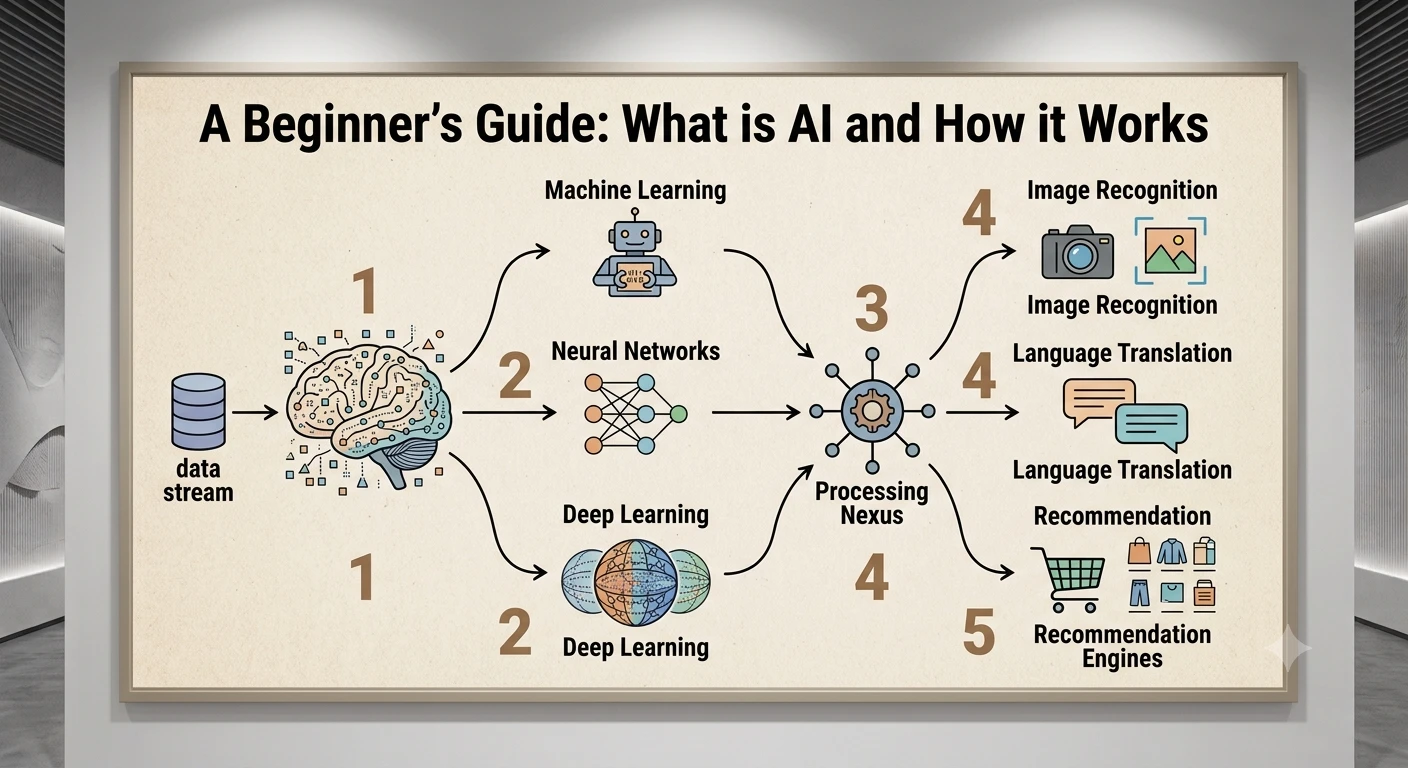
A plain-language walkthrough of what AI actually is under the hood, minus the sci-fi buzzwords.
1. Introduction — Why AI Is Everywhere Now
Artificial Intelligence (AI) has moved from science fiction into everyday life faster than almost any technology in history. It suggests what to watch next, unlocks your phone with your face, answers your questions in tools like ChatGPT, drives cars, detects diseases in medical scans, and even writes computer code. Yet for most people, AI still feels like a mysterious black box — something powerful but hard to actually understand.
This guide is written for complete beginners. There is no assumption that you know how to code, or that you have a background in math or computer science. By the end, you will have a clear, accurate mental model of what AI is, how it works under the hood, and why it behaves the way it does — including its very real limitations.
Think of this as the explanation you wish someone had given you the first time you heard the term "AI."
2. What Is Artificial Intelligence, Really?
At its core, Artificial Intelligence is the field of computer science focused on building machines that can perform tasks which normally require human intelligence. This includes things like recognizing images, understanding language, making decisions, solving problems, and learning from experience.
It's important to understand that AI is not one single technology — it's an umbrella term, similar to how "vehicle" covers bicycles, cars, and airplanes. Under that umbrella are several related but distinct concepts:
- Artificial Intelligence (AI): The broad goal — making machines act intelligently.
- Machine Learning (ML): A subset of AI where systems learn patterns from data instead of being explicitly programmed with rules.
- Deep Learning: A subset of machine learning that uses layered structures called neural networks, loosely inspired by the human brain.
- Generative AI: A subset of deep learning that creates new content — text, images, audio, or video — rather than just analyzing existing data.
So when someone says "AI," they usually mean one of these more specific things. A simple spam filter and a chatbot like Claude or ChatGPT are both technically "AI," but they work in very different ways and have very different capabilities.
3. A Brief History of AI
AI is not a new idea — the term was coined in 1956 at a conference at Dartmouth College, where researchers proposed that "every aspect of learning... can be so precisely described that a machine can be made to simulate it." The decades since have seen cycles of excitement followed by disappointment, often called "AI winters," when progress stalled and funding dried up.
- 1950s–1960s: Early AI research explores logic, symbolic reasoning, and simple game-playing programs.
- 1980s: "Expert systems" — rule-based programs — become popular in business, then fall out of favor.
- 1997: IBM's Deep Blue defeats world chess champion Garry Kasparov.
- 2012: A breakthrough in deep learning (AlexNet) dramatically improves image recognition, sparking the modern AI boom.
- 2016: DeepMind's AlphaGo defeats a world champion at the ancient board game Go.
- 2022–present: Large language models like ChatGPT and Claude bring generative AI to hundreds of millions of everyday users.
What changed recently isn't the core idea of AI — it's that we now have vastly more computing power, vastly more digital data, and improved algorithms, all arriving at the same time.
4. The Building Blocks: Data, Algorithms, and Models
To understand how AI works, it helps to know three core ingredients that go into every AI system:
Data
Data is the raw material AI learns from — text, images, numbers, audio, or video. Just as a student learns by reading books and practicing problems, an AI system learns by being shown huge amounts of examples. The quality and quantity of this data heavily determines how good the resulting system will be.
Algorithms
An algorithm is a set of mathematical rules or steps used to find patterns in data. In traditional programming, a human writes explicit instructions ("if this, then that"). In machine learning, the algorithm instead searches for patterns on its own by adjusting internal parameters until it gets better at a task.
Models
A model is the end result — the "trained" system that has learned from data using an algorithm. When you interact with an AI tool, you are talking to a model: a mathematical structure containing millions or billions of adjustable numbers, called parameters, that encode everything the system has learned.
5. How Machines Actually "Learn"
The phrase "machine learning" can sound almost magical, but the underlying process is closer to trial-and-error, guided by math, than to human-style understanding. Here is a simplified version of the learning process, called training :
- Step 1 — Show an example: The system is given an input (e.g., a photo) along with the correct answer (e.g., "this is a cat").
- Step 2 — Make a guess: The model, which starts out essentially random, makes a prediction.
- Step 3 — Measure the error: A "loss function" calculates how wrong the guess was compared to the correct answer.
- Step 4 — Adjust and improve: Using a technique called backpropagation and an optimization method called gradient descent , the model slightly adjusts its internal numbers to reduce the error next time.
- Step 5 — Repeat, millions of times: This cycle repeats across enormous datasets until the model's predictions become reliably accurate.
There are three broad categories of learning used to train these systems:
| Learning Type | How It Works | Example |
|---|---|---|
| Supervised Learning | Learns from labeled examples (input + correct answer) | Spam vs. not-spam email detection |
| Unsupervised Learning | Finds hidden patterns in unlabeled data on its own | Customer segmentation in marketing |
| Reinforcement Learning | Learns by trial and error, receiving rewards or penalties | Game-playing AI, robotics |
Once training is complete, the model is used in what's called inference mode — simply applying what it has learned to new, unseen inputs, without any further learning happening in real time. This is what happens every time you ask a chatbot a question.
6. Neural Networks and Deep Learning Explained Simply
Most modern AI systems are powered by artificial neural networks — a structure loosely inspired by how neurons in the human brain connect and pass signals to one another. Don't worry — you don't need biology to understand this; think of it as layers of simple math functions stacked together.
The basic structure
- Input layer: Receives the raw data (e.g., the pixels of an image, or words in a sentence).
- Hidden layers: Multiple layers of "neurons" (small mathematical units) that each transform the data slightly, gradually detecting more complex patterns — edges, then shapes, then objects, for example.
- Output layer: Produces the final answer (e.g., "90% confident this is a dog").
Each connection between neurons has a weight — a number that determines how much influence one neuron has on the next. Training a neural network essentially means finding the right combination of millions (or billions) of these weights so that the network produces accurate outputs.
"Deep" learning simply refers to neural networks with many hidden layers stacked on top of each other — sometimes hundreds. The extra depth allows the network to build up increasingly abstract, sophisticated representations of the data, which is why deep learning has proven so much more powerful than earlier, shallower techniques.
7. How Large Language Models (like ChatGPT) Work
Tools like ChatGPT and Claude are built on a specific type of deep learning architecture called the Transformer , introduced by Google researchers in 2017. Large Language Models (LLMs) are trained on enormous amounts of text from books, websites, and other sources.
At the simplest level, an LLM is a very sophisticated next-word predictor During training, the model is repeatedly shown text with the last word hidden, and asked to predict it. By doing this billions of times across a massive volume of text, the model gradually develops an internal, mathematical representation of grammar, facts, reasoning patterns, and even style.
- Tokenization: Text is broken into small chunks called tokens (roughly word-pieces).
- Embeddings: Each token is converted into a list of numbers representing its meaning in a mathematical space, so that similar words end up numerically close together.
- Attention: The Transformer's key innovation — a mechanism that lets the model weigh how much every word in a sentence should influence every other word, which is how it captures context and meaning over long passages.
- Generation: The model predicts the most likely next token, adds it to the text, and repeats this process one token at a time to produce a full response.
Important nuance: an LLM does not "look things up" in a database when it answers you. It generates each response fresh, based on patterns learned during training — which is also why these models can sometimes confidently produce incorrect information, a phenomenon often called a "hallucination."
8. Types of AI: Narrow AI vs General AI vs Superintelligence
- Narrow AI (Artificial Narrow Intelligence – ANI): Designed to perform one specific task well — recommendation engines, voice assistants, spam filters, image generators. Every AI system in existence today, including the most advanced chatbots, falls into this category.
- General AI (Artificial General Intelligence – AGI): A hypothetical system that could match human intelligence across virtually any task, learning and reasoning as flexibly as a person. AGI does not currently exist, and experts disagree on when — or whether — it will be achieved.
- Superintelligence (ASI): A theoretical future stage where AI would surpass human intelligence across all domains. This remains speculative and is a subject of ongoing research and debate.
Nearly everything you interact with today — including Claude, ChatGPT, self-driving car systems, and recommendation algorithms — is Narrow AI. These systems can be extraordinarily capable within their domain, but none of them possess general understanding or awareness the way humans do.
9. Real-World Applications of AI
| Industry | Example Use Cases |
|---|---|
| Healthcare | Analyzing medical scans, drug discovery, predicting patient risk |
| Finance | Fraud detection, algorithmic trading, credit scoring |
| Transportation | Self-driving vehicles, traffic prediction, route optimization |
| Retail & Marketing | Product recommendations, demand forecasting, chatbots |
| Education | Personalized tutoring, automated grading, adaptive learning tools |
| Entertainment | Content recommendations, music/video generation, game AI |
| Everyday Life | Voice assistants, spam filters, photo organization, translation |
10. Benefits of AI
- Speed and scale: AI can process and analyze information far faster than humans, at massive scale.
- Consistency: Unlike humans, AI systems don't get tired, distracted, or bored, leading to consistent performance on repetitive tasks.
- Pattern detection: AI can spot subtle patterns in huge datasets — such as early signs of disease in medical images — that might be difficult for humans to notice.
- Accessibility: Tools like translation, voice-to-text, and AI tutors can make information and services more accessible to more people.
- Automation of routine work: Freeing up human time for more creative, strategic, or relationship-based work.
11. Limitations, Risks, and Ethical Concerns
Understanding AI honestly means understanding what it cannot do well, and where real risks exist:
- Bias: AI systems learn from historical data, and if that data reflects human biases, the model can reproduce or even amplify them.
- Hallucinations and errors: Generative AI can produce confident-sounding but incorrect information, since it predicts plausible text rather than verifying facts.
- Lack of true understanding: Even highly capable models operate through statistical pattern matching rather than genuine comprehension, consciousness, or common sense reasoning in the human sense.
- Data privacy: Training and using AI often involves large amounts of personal data, raising questions about consent and security.
- Job displacement: Automation of certain tasks can disrupt specific jobs and industries, even as it creates new roles elsewhere.
- Misuse potential: Like any powerful technology, AI can be misused — for deepfakes, disinformation, or surveillance — which is why responsible development and regulation matter.
Because of these concerns, an entire field called AI safety and ethics has emerged, focused on making AI systems more transparent, fair, controllable, and aligned with human values.
12. The Future of AI
Predicting the future of any fast-moving technology is difficult, but a few trends are already visible:
- Multimodal AI: Systems that can seamlessly understand and generate text, images, audio, and video together, rather than handling each separately.
- AI agents: Systems that don't just answer questions but can take multi-step actions on a person's behalf — browsing the web, using software tools, or writing and running code.
- Greater efficiency: Ongoing research into making powerful models smaller, faster, and cheaper to run, expanding access beyond large companies.
- Regulation and governance: Governments worldwide are developing frameworks to govern how AI is built, deployed, and used responsibly.
- Human-AI collaboration: Rather than full replacement, much of the near-term impact is expected to come from AI acting as a capable assistant that amplifies human work.
Whatever direction it takes, understanding the fundamentals covered in this guide — data, training, neural networks, and their real capabilities and limits — will help you engage with AI thoughtfully, rather than either fearing it blindly or trusting it uncritically.
13. Conclusion
Artificial Intelligence is not magic, and it is not a single monolithic technology — it is a broad field built on a fairly understandable foundation: large amounts of data, mathematical algorithms that detect patterns, and models that are trained through repeated trial-and-error adjustment. Machine learning lets systems improve from data instead of explicit rules; deep learning uses layered neural networks to handle increasingly complex patterns; and today's generative AI tools, like large language models, apply these ideas at massive scale to understand and generate human-like text.
AI's rapid rise brings enormous benefits — in healthcare, education, business, and daily convenience — alongside real challenges around bias, misinformation, privacy, and the changing nature of work. Neither blind enthusiasm nor blanket fear serves us well. The most useful approach is an informed one: understanding what these systems actually do, where they excel, where they fall short, and how to use them responsibly.
Hopefully, this guide has replaced some of the mystery around AI with a clear, practical understanding — one you can build on as this technology continues to evolve.
"The best way to predict the future is to understand the present." — Understanding how AI actually works today is the first step toward navigating what comes next.